
Molecular evidence for a relict marine community in an Antarctic Dry Valleys subglacial brine-fed system
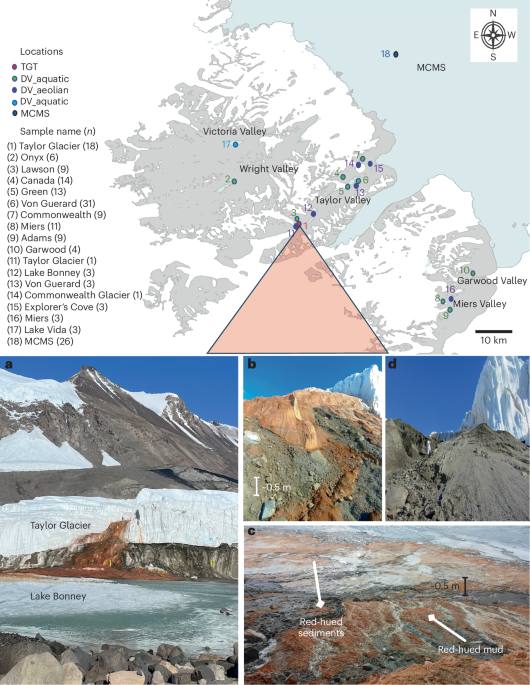
The McMurdo Dry Valleys contain a mosaic of specialized microbial habitats structured by strong physical and chemical gradients. Blood Falls, located at the terminus of the Taylor Glacier, is a red, iron-rich outflow of deep Antarctic subglacial brine with geochemical and isotopic evidence supporting a potential ancient marine origin. Previous studies suggest the brine formed when seawater inundated the Taylor Valley over warm climatic intervals before becoming isolated beneath the advancing glacier. Here, across 167 aquatic, sediment and aeolian samples from the McMurdo Dry Valleys and marine reference sites, we identified a distinct marine micro-eukaryotic assemblage restricted to red-hued ice, mud and sediment at the Taylor Glacier terminus. Marine indicator species were identified across several phylogenetic groups including diatoms, haptophytes, dinoflagellates and ciliates. Metatranscriptomic profiles revealed transcriptionally active phototrophs with enriched pathways for photosynthesis, osmotic stress responses and cellular repair. Haplotype networks showed lineage-specific divergence between Taylor Glacier terminus and McMurdo Sound diatoms, supporting geographic isolation. These findings indicate that the subglacial brine-fed system at the Taylor Glacier terminus retains marine-derived biological signatures long after physical separation from the ocean, linking contemporary Antarctic microbial assemblages to past climatic transitions. Eukaryotic microorganisms within a subglacial brine-fed system in the McMurdo Dry Valleys of Antarctica are largely of marine origin, a legacy of past incursions of seawater into the area, according to RNA sequencing and metatranscriptomic analyses.