
NASA Captures Comet Disintegrating Near Sun During Close Flyby
NASA Captures Comet Disintegrating Near Sun During Close Flyby
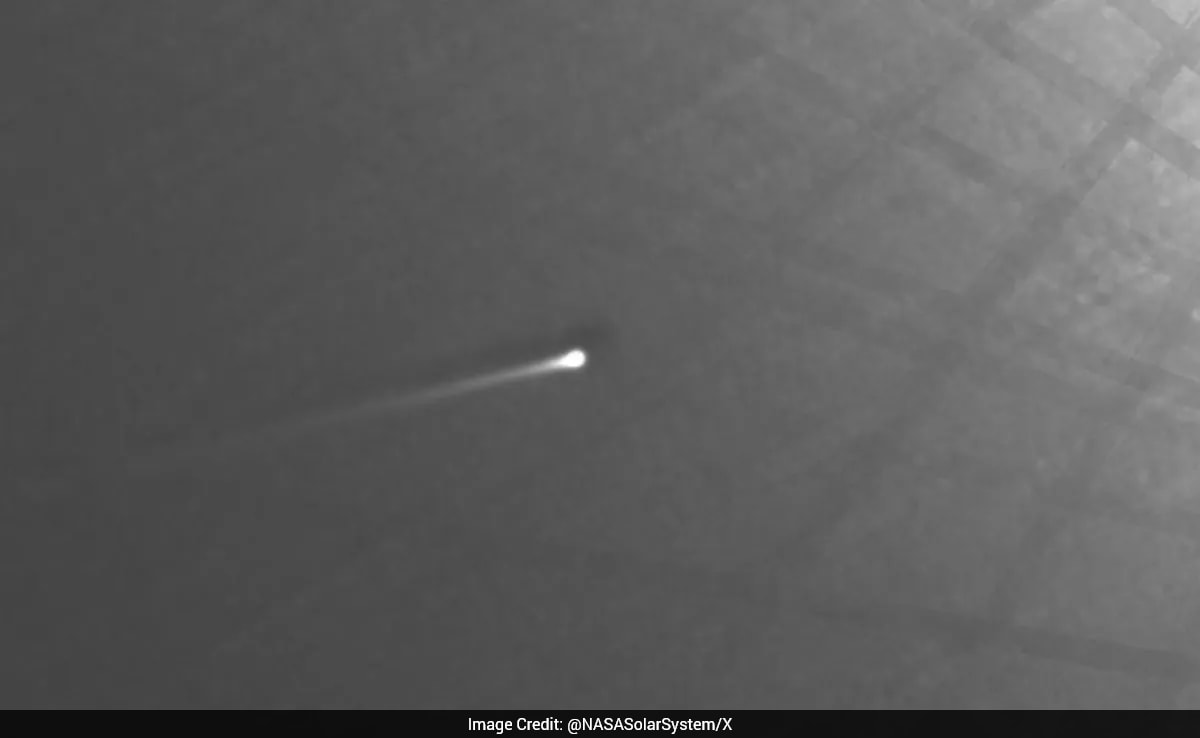
On April 4, 2026, the cosmic ballet of our solar system took a dramatic turn as comet C/2026 A1, affectionately dubbed MAPS, made its close approach to the Sun. This celestial event, marked by both excitement and caution, offered a rare glimpse into the transient nature of comets and their often-fragile structure. As it ventured within a distance roughly twice that of the Moon's orbit around Earth, the comet's fate took a startling twist, culminating in a spectacular disintegration that captivated astronomers and skywatchers alike.
A Close Encounter with the Sun
Comet C/2026 A1 (MAPS) was first identified in early 2026 and quickly gained attention as it approached the inner solar system. Its orbit brought it close to the Sun, providing an opportunity for scientists to observe its behavior under the intense solar radiation and gravitational forces. The close flyby, which occurred at approximately 384,400 kilometers (238,855 miles) from Earth, allowed for unprecedented observations from various space-based telescopes and instruments.
As the comet neared the Sun, it became increasingly active, shedding gas and dust as it heated up. This phenomenon, known as outgassing, is typical for comets, which are primarily composed of ice, dust, and rocky material. However, the intensity of the Sun's heat can trigger dramatic changes, often leading to the disintegration of these celestial bodies.
The Disintegration Event
As C/2026 A1 (MAPS) continued its approach, NASA's Solar and Heliospheric Observatory (SOHO) and other observatories began to capture images and data that would later reveal the comet's fate. Astronomers were on high alert, hoping to witness a spectacular display of cosmic fireworks. Unfortunately, what they encountered was a disheartening spectacle: the comet began to fragment into several pieces as it neared perihelion, the point in its orbit closest to the Sun.
The disintegration event was caused by the immense gravitational pull and heat from the Sun. These forces can cause the volatile materials within a comet to evaporate rapidly, creating pressure that can fracture the comet's nucleus. In this case, C/2026 A1 (MAPS) displayed a spectacular breakup, scattering its remnants across the solar system.
Scientific Implications
The disintegration of comet C/2026 A1 (MAPS) has significant implications for our understanding of cometary behavior and the evolution of these celestial objects. Comets are often considered time capsules, preserving the primordial materials from the formation of our solar system over 4.5 billion years ago. By studying their composition and behavior, scientists can glean insights into the conditions that prevailed during the early solar system and the processes that shape these icy bodies.
Moreover, this event highlights the dynamic nature of our solar system, where even the most stable objects can undergo rapid changes. Researchers will analyze the data collected during the flyby to better understand the mechanisms that lead to a comet's disintegration, contributing to the broader field of planetary science and stellar evolution.
The Future of Comet Research
The disintegration of C/2026 A1 (MAPS) is not an isolated incident; many comets have met a similar fate during their close encounters with the Sun. As technology continues to advance, scientists are optimistic about the ability to predict such events and enhance our understanding of these celestial wanderers. Future missions, including upcoming space telescopes and innovative observational techniques, are expected to provide more detailed data on the life cycles of comets.
In addition to unraveling the mysteries of comets, this incident serves as a reminder of the fragility of these cosmic travelers. As we continue to explore our solar system and beyond, the insights gained from events like the disintegration of C/2026 A1 (MAPS) will be invaluable in our quest to comprehend the universe's complexities.
Conclusion
As we reflect on the disintegration of comet C/2026 A1 (MAPS), we are reminded of the delicate balance between beauty and chaos that defines our celestial neighborhood. The comet's close flyby and subsequent breakup not only provided a stunning visual spectacle but also enriched our scientific understanding of these fascinating objects. With each comet that passes through our solar system, we gain a deeper appreciation for the dynamic processes at play and the mysteries that await discovery.
NASA's ongoing commitment to exploring our solar system ensures that future generations will continue to witness and learn from these cosmic events. As we look to the stars, the story of C/2026 A1 (MAPS) serves as a poignant chapter in the ever-evolving narrative of our universe, reminding us of the wonders that lie beyond our world.