
The discovery of two little red dots in transition into quasars
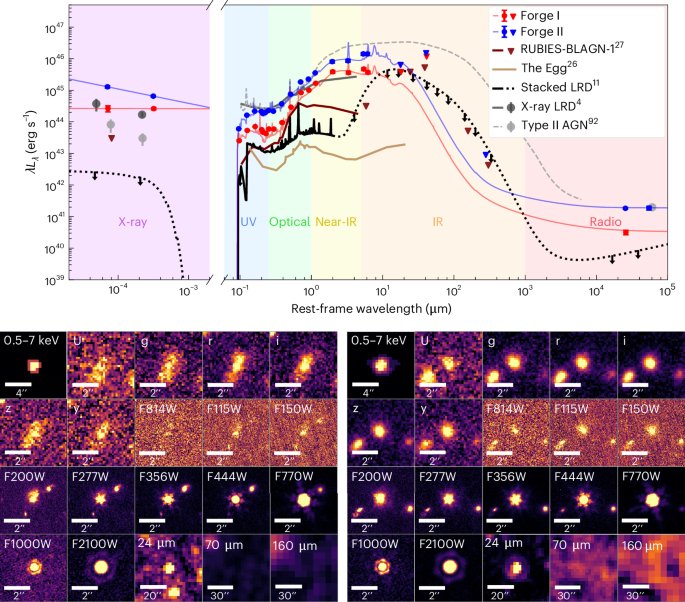
JWST has uncovered a population of compact objects that show a unique V-shaped spectral energy distribution in the ultraviolet and optical wavelength range. These so-called little red dots (LRDs) often exhibit broad Balmer emission lines, indicative of the presence of active galactic nuclei (AGNs). They generally lack detection of X-ray, radio and mid-infrared radiation, which is fundamentally different from typical AGNs. Various models, including super-Eddington-accreting black holes enshrouded in dense and dust-poor gas, have been proposed to explain these features. However, the nature of LRDs remains debated and their evolutionary fate is unclear. Here we report two unusual LRDs at redshifts of 2.871 and 2.930 that are in a transitional phase towards typical AGNs. Their V-shaped spectral energy distributions, compact optical morphology and broad emission lines satisfy the defining criteria of LRDs. However, they exhibit intense X-ray, radio and mid-infrared radiation that is much stronger than previously known LRDs. These hybrid properties suggest that the dense gas envelope around their central black holes is dispersing, allowing high-energy photons and radio emission to escape. Meanwhile, a dust torus is forming. This finding provides a direct insight into the nature of LRDs and indicates that at least some LRDs will evolve into AGNs or quasars at later times. Two unique little red dots exhibit intense X-ray, radio and mid-infrared radiation, and may be transitioning into quasars. In this scenario, little red dots could represent an early evolutionary stage of supermassive black hole growth.