
These blue cosmic explosions might not be a mystery anymore
# The Enigma of Blue Cosmic Explosions: Unraveling the Mystery Behind Luminous Fast Blue Optical Transients
In the vast expanse of the cosmos, few phenomena capture the imagination of astronomers and space enthusiasts alike quite like Luminous Fast Blue Optical Transients (LFBOTs). These mysterious blue cosmic explosions have long puzzled scientists, hinting at the violent and intricate processes that govern our universe. Recent research suggests a new theory: that these dazzling bursts of light may originate from the catastrophic collisions of black holes with massive stars. This groundbreaking revelation not only sheds light on the nature of these enigmatic events but also opens new avenues for understanding the cosmic dance between black holes and stellar mass.
## What Are Luminous Fast Blue Optical Transients?
LFBOTs are a class of astronomical events characterized by their rapid brightness and distinctive blue hue. Discovered relatively recently, these transient events emit intense bursts of light that can outshine entire galaxies in mere moments. Their short-lived nature—lasting only a few days to weeks—combined with their brilliant luminosity makes them particularly fascinating to astronomers.
These phenomena are distinct from supernovae, which are the explosive deaths of stars, and gamma-ray bursts, which are intense beams of gamma radiation resulting from massive stellar collapses. Instead, LFBOTs appear to represent a different type of cosmic explosion that has eluded comprehensive scientific explanation until now.
## The Origins of LFBOTs: A New Theory Emerges
For years, the origins of LFBOTs remained a mystery, with various hypotheses proposed to explain their existence. Some scientists suggested that they could be linked to the deaths of massive stars or the activity of magnetars—neutron stars with exceptionally strong magnetic fields. However, these theories struggled to account for the unique characteristics exhibited by LFBOTs.
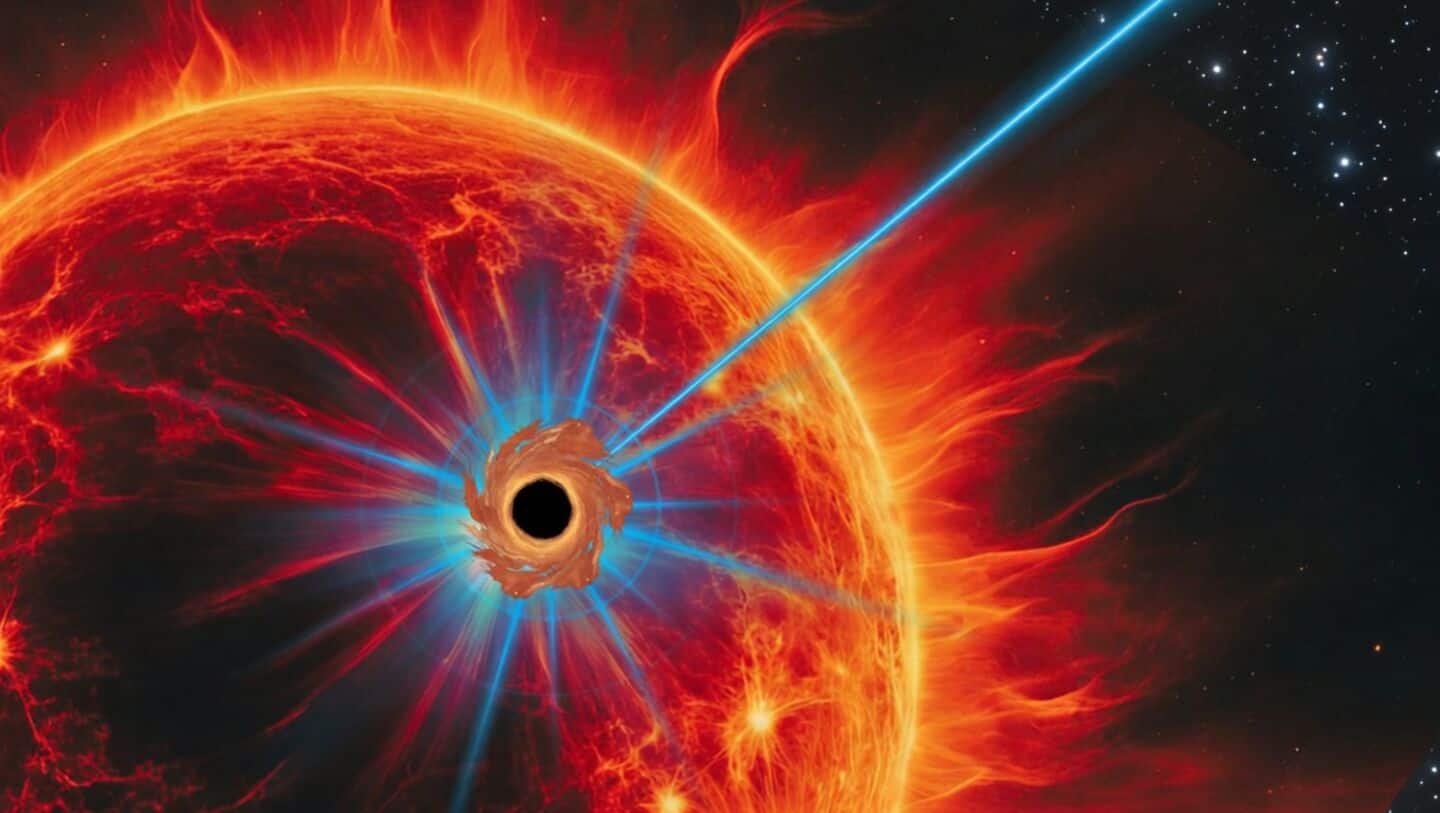
Recent studies, however, have pointed towards a more compelling explanation: the collision of black holes with massive stars. This theory posits that when a black hole enters the gravitational influence of a massive star, it can disrupt the star's structure, leading to a violent release of energy and the characteristic blue light associated with LFBOTs.
The Mechanism Behind the Explosion
The process begins when a black hole approaches a massive star, drawn in by its gravitational pull. As it approaches, the black hole exerts immense tidal forces, distorting the star and eventually leading to its destruction. This catastrophic interaction can result in the ejection of stellar material at incredible speeds, creating shock waves that generate the luminous explosion observed as an LFBOT.
This interaction not only produces a brief but intense burst of light but also emits gravitational waves—ripples in spacetime that can be detected by observatories on Earth. The combination of electromagnetic radiation and gravitational waves provides a rich dataset for astronomers, allowing them to study the underlying physics of such cosmic events in unprecedented detail.
## Observing LFBOTs: The Role of Advanced Technology
The identification and study of LFBOTs have been made possible by advancements in observational technology. Space telescopes equipped with sensitive instruments can capture the fleeting flashes of these explosions, while ground-based observatories contribute to the ongoing analysis of their properties. Collaboration between various astronomical institutions has led to a more comprehensive understanding of these phenomena.
For example, the Zwicky Transient Facility (ZTF) has played a crucial role in the detection of LFBOTs. By monitoring the night sky for transient events, astronomers have successfully identified multiple instances of these cosmic explosions, allowing for detailed follow-up observations. The data collected from such observations have provided insights into the potential mechanisms driving LFBOTs and their implications for our understanding of the cosmos.
The Importance of Collaboration in Astronomy
This research underscores the importance of collaboration in the scientific community. The study of LFBOTs involves astronomers from various disciplines and institutions worldwide, each contributing their expertise to unravel the complexities of these phenomena. The sharing of data and resources has accelerated the pace of discovery, highlighting the interconnectedness of modern scientific endeavors.
## Implications for Our Understanding of the Universe
The implications of this new theory regarding the origins of LFBOTs extend beyond the events themselves. Understanding how black holes interact with massive stars can provide valuable insights into stellar evolution, the lifecycle of stars, and the behavior of black holes—one of the most enigmatic entities in the universe.
Insights into Stellar Evolution and Black Hole Formation
The interactions between black holes and massive stars may also shed light on the processes that lead to the formation of black holes. As massive stars evolve and reach the end of their life cycle, they can collapse into black holes. Understanding how these black holes form and evolve can help astronomers piece together the history of star formation in the universe and the role black holes play in galactic dynamics.
Additionally, studying LFBOTs can enhance our understanding of the distribution of matter in the universe. The explosions resulting from these collisions can eject material into space, contributing to the cosmic ecosystem and influencing the formation of new stars.
## Conclusion: A New Chapter in Cosmic Exploration
The recent revelations regarding Luminous Fast Blue Optical Transients mark a significant milestone in our quest to comprehend the universe. As researchers continue to investigate the origins and mechanisms behind these blue cosmic explosions, we stand on the brink of a deeper understanding of the fundamental processes that shape our cosmos.
The collision of black holes with massive stars offers a tantalizing glimpse into the intricate interactions that govern celestial bodies. As technology continues to advance and collaborations among astronomers flourish, the mysteries surrounding LFBOTs and other cosmic phenomena will undoubtedly continue to unravel.
With each discovery, we inch closer to a comprehensive understanding of the universe's complexities and the forces that drive its evolution. In the grand tapestry of cosmic exploration, the study of LFBOTs represents a vibrant thread, illuminating the path forward as we seek to unlock the secrets of the stars.