
TRAM promotes Toll-like-receptor-free myddosome signal transduction
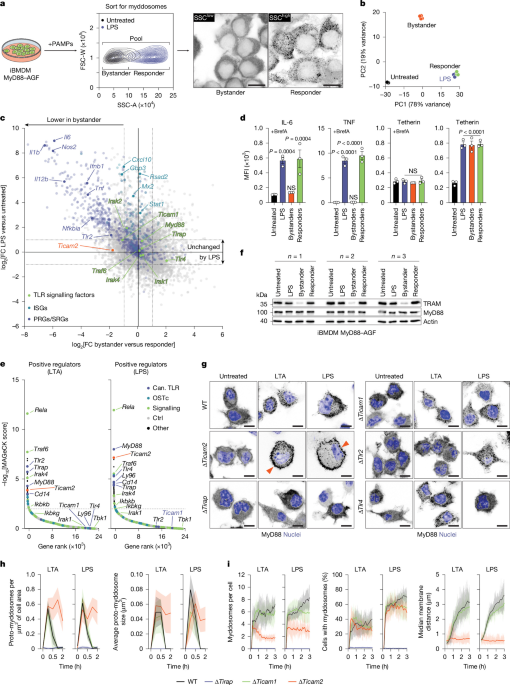
In the Toll-like receptor (TLR) signal transduction pathways, activated receptors are present for mere minutes within the initial, membrane-proximal signalling complexes called proto-myddosomes1. Proto-myddosomes are rapidly released from TLRs to self-assemble (that is, mature) into enzyme-rich, cytosolic supramolecular organizing centres called myddosomes2–4. Myddosomes induce hours-long inflammatory gene expression5–10. The mechanism controlling proto-myddosome release and its effect on signal transduction are undefined. Here we identify factors that regulate the maturation process of proto-myddosomes into receptor-free cytosolic myddosomes11. Through a genetic screen in macrophages, we identify TRAM, which was previously described to control MyD88-independent TLR signalling, as a regulator of myddosome assembly. Using biochemistry, live-cell imaging and activity reconstitution with recombinant proteins, we show that the plasma-membrane-associated adapter TIRAP seeds proto-myddosomes12,13, after which TRAM dissociates MyD88 from the TLR–TIRAP complex to enable myddosome maturation and downstream signal transduction14–19. In the absence of TRAM, MyD88 cannot dissociate from the TLR–TIRAP complex, resulting in abnormal and unstable MyD88 interactions with downstream signalling enzymes. These findings enabled us to identify TRAM-dependent long-lasting myddosome activities as the determinant of two TLR pathway hallmarks: hours-long NF-κB activation20–24 and secondary response gene expression25–27. Chemical dissociation of cytosolic myddosomes disrupted existing inflammatory activities of TLR-stimulated cells in vitro and in vivo. Collectively, this work establishes TRAM as a regulator of myddosome maturation and signalling, providing the molecular basis for receptor-free signal transduction. TRAM is a regulator of myddosome assembly through dissociating MyD88 from the TLR–TIRAP complex to enable myddosome maturation and durable downstream signal transduction.