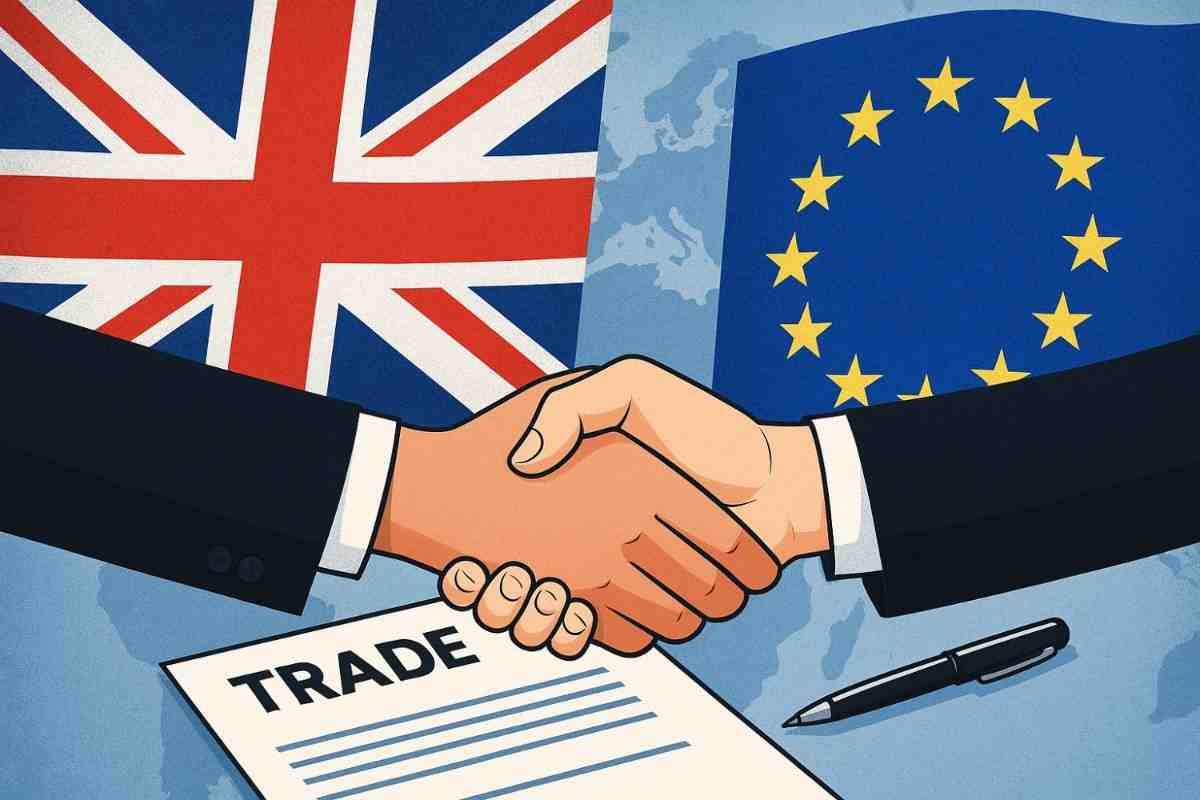
UK–EU Trade Talks Enter Critical Phase as Both Sides Push for Stability
UK Immigration Overhaul: New Rules for Workers, Students and Families read more
https://www.theglobalvission.com/category_details.php?id=102
🌍 Global Reactions: Why the World Is Watching
🇺🇸 United States
U.S. officials told Reuters that stable UK–EU relations are “critical for global supply chains.”
🇮🇳 India
India, which has strong trade ties with both regions, welcomes discussions.
ONS data shows India is among the UK’s top non-EU trade partners.
🇨🇳 China
Chinese analysts view the negotiations as a measure of EU’s policy strength during global economic competition.
---
📊 Economic Impact: What Experts Predict
📈 If Talks Succeed
Lower customs costs
Faster goods movement
More stable supply chains
Boost in SME exports
Higher foreign investment confidence
📉 If Talks Fail
Renewed border delays
Rising trade costs
Market instability
Pound Sterling weakness
Business uncertainty
ONS statistics indicate trade friction costs the UK billions annually.
---
🔍 Statements from Leaders
🇬🇧 UK Government Position
In a statement by the UK Department for Business & Trade, officials said their goal is to:
“Protect British economic sovereignty”
“Reduce regulatory burdens for businesses”
“Ensure predictable market access”
🇪🇺 European Union Position
The European Commission insists:
“Single market integrity is non-negotiable”
“Simplification must align with legal obligations”
---
🧭 Long-Term Outlook
BBC-style analysis shows three possible outcomes:
🟢 1. Full Trade Revision Deal (Most Positive)
A broad agreement covering customs, digital trade, and energy cooperation.
🟡 2. Mini-Deals (Sector-Specific)
Partial agreements in growth sectors only.
🔴 3. Negotiation Breakdown
Worst-case scenario affecting markets and exporters.
---
📝 Conclusion
The UK–EU trade negotiations represent a defining moment for Europe’s economic future.
With global markets unstable and political tensions rising, both sides recognise that a stable, cooperative framework is in their mutual interest.
Whether they can overcome years of post-Brexit division will shape the continent’s economic outlook for years to come.
---
🔗 SOURCES & BACKINGS
Primary Sources:
European Commission – Official Trade Policy Briefing
UK Department for Business & Trade – Ministerial Statement
Backings / Data Verification:
Office for National Statistics (ONS) – UK Trade Data Report
Reuters EU Policy Desk – Independent Analysis & Statements
">
📍 Brussels | 10 December 2025
📰 By The Global Vission World News Desk
🌍 UK–EU Trade Negotiations Enter Critical Phase as Both Sides Push for Long-Term Economic Stability
The United Kingdom and the European Union have entered what officials describe as a “critical and time-sensitive phase” of renewed trade negotiations. According to the European Commission’s latest trade briefing, both sides are working to ease post-Brexit trade friction, stabilise supply chains, and create long-term regulatory alignment in key sectors.
The talks arrive at a moment when the UK and EU are grappling with high inflation, slowing GDP growth, and global geopolitical uncertainty. Analysts say a stable UK–EU trade pathway is “essential for Europe’s economic resilience and competitiveness.”
---
🇬🇧 Why the New Negotiations Matter
Since Brexit, UK–EU relations have been marked by disputes over customs checks, border delays, and regulatory divergence.
The UK Department for Business & Trade (DBT) states that unresolved trade barriers continue to affect British exporters, increasing operational costs and reducing market access.
Key industries impacted include:
⚠️ Manufacturing
⚠️ Automotive
⚠️ Pharmaceuticals
⚠️ Agriculture & Food Supply
⚠️ Small businesses reliant on EU exports
---
🇪🇺 What Are the Key Issues Being Negotiated?
According to documents published by the European Commission, the current negotiation round covers five major areas:
---
🔹 1. Regulatory Alignment & Product Standards
A major stumbling block post-Brexit has been the need for dual certification for goods entering the EU single market.
The European Commission said in its briefing that limited regulatory cooperation could be possible if the UK commits to transparency and periodic alignment with EU standards.
---
🔹 2. Customs & Border Simplification
Border complications, especially regarding Northern Ireland, remain sensitive.
The UK DBT has proposed a digital customs corridor, reduced paperwork, and near-instant vehicle clearance processes.
The EU has signaled conditional support, provided single-market integrity remains intact.
---
🔹 3. Digital Trade & Data Protection
Both sides acknowledge that digital trade is the fastest-growing sector.
Priority areas:
💻 Digital goods movement
🔐 Cross-border data adequacy
🛡 Joint cybersecurity systems
🤖 AI regulatory cooperation
A senior EU official told Reuters that digital trade must reflect “trusted and secure cross-border standards.”
---
🔹 4. Energy Security & Green Transition Cooperation
Given the global volatility in energy markets, negotiations include:
Renewable energy sharing
Green technology investment
Electricity grid integration
LNG supply coordination
EU documents show support for a “joint green framework” between the UK and EU.
---
🔹 5. Skilled Labour Mobility (Sector-Specific)
While free movement will not return, both sides are exploring limited mobility arrangements for:
Researchers
Health workers
Tech professionals
Artists & performers
The Commission notes that such pathways could strengthen “innovation and cultural cooperation.
UK Immigration Overhaul: New Rules for Workers, Students and Families read more
https://www.theglobalvission.com/category_details.php?id=102
🌍 Global Reactions: Why the World Is Watching
🇺🇸 United States
U.S. officials told Reuters that stable UK–EU relations are “critical for global supply chains.”
🇮🇳 India
India, which has strong trade ties with both regions, welcomes discussions.
ONS data shows India is among the UK’s top non-EU trade partners.
🇨🇳 China
Chinese analysts view the negotiations as a measure of EU’s policy strength during global economic competition.
---
📊 Economic Impact: What Experts Predict
📈 If Talks Succeed
Lower customs costs
Faster goods movement
More stable supply chains
Boost in SME exports
Higher foreign investment confidence
📉 If Talks Fail
Renewed border delays
Rising trade costs
Market instability
Pound Sterling weakness
Business uncertainty
ONS statistics indicate trade friction costs the UK billions annually.
---
🔍 Statements from Leaders
🇬🇧 UK Government Position
In a statement by the UK Department for Business & Trade, officials said their goal is to:
“Protect British economic sovereignty”
“Reduce regulatory burdens for businesses”
“Ensure predictable market access”
🇪🇺 European Union Position
The European Commission insists:
“Single market integrity is non-negotiable”
“Simplification must align with legal obligations”
---
🧭 Long-Term Outlook
BBC-style analysis shows three possible outcomes:
🟢 1. Full Trade Revision Deal (Most Positive)
A broad agreement covering customs, digital trade, and energy cooperation.
🟡 2. Mini-Deals (Sector-Specific)
Partial agreements in growth sectors only.
🔴 3. Negotiation Breakdown
Worst-case scenario affecting markets and exporters.
---
📝 Conclusion
The UK–EU trade negotiations represent a defining moment for Europe’s economic future.
With global markets unstable and political tensions rising, both sides recognise that a stable, cooperative framework is in their mutual interest.
Whether they can overcome years of post-Brexit division will shape the continent’s economic outlook for years to come.
---
🔗 SOURCES & BACKINGS
Primary Sources:
European Commission – Official Trade Policy Briefing
UK Department for Business & Trade – Ministerial Statement
Backings / Data Verification:
Office for National Statistics (ONS) – UK Trade Data Report
Reuters EU Policy Desk – Independent Analysis & Statements