
Urinary haloacetic acid concentrations and asthenozoospermia risk: a case-control study in China
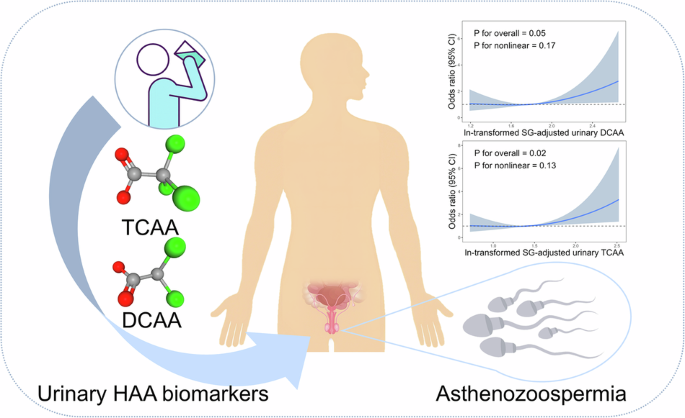
Disinfection byproducts (DBPs), particularly haloacetic acids (HAAs), exhibit male reproductive toxicity. However, their associations with asthenozoospermia remain unclear. To investigate associations of urinary trichloroacetic acid (TCAA) and dichloroacetic acid (DCAA), the predominant HAAs, with asthenozoospermia risk, and further to evaluate their joint effects. An age-matched case-control study (135 asthenozoospermia cases and 270 controls) nested within the TREE cohort was conducted. Repeated measurements of urinary HAAs were utilized to improve exposure assessment. Associations were assessed using conditional logistic regression, and additive and multiplicative interactions analyses. Higher levels of urinary DCAA and TCAA were associated with an increased risk of asthenozoospermia (OR = 2.05; 95% CI: 1.10, 3.83; P for trend = 0.04 and OR = 2.13; 95% CI: 1.11, 4.09; P for trend = 0.05 for the highest vs. lowest quartiles of urinary DCAA and TCAA, respectively). Co-exposure to high levels of both DCAA and TCAA had a 2.62-fold (95% CI: 1.48, 4.69) higher risk of asthenozoospermia relative to low both such exposures, with evidence of multiplicative (P = 0.01) and additive interactions (RERI = 1.98, 95% CI: 0.61, 4.40; AP = 0.76, 95% CI: 0.29, 1.04). Exposures to TCAA and DCAA are individually associated with increased risk of asthenozoospermia, and co-exposure to such two compounds suggest an additive effect. These findings highlight the importance of assessing joint effects of two HAA biomarkers on male reproduction.